

AI is no longer just improving how individual tasks get done. It’s starting to change how organizations actually work and grow.
For years, most organizations relied on a familiar model. People did the work. Processes held things together. Growth was measured in hours, headcount, and effort. That model is under real pressure now. Intelligence and automation are becoming central to how decisions are made, how services are delivered, and how organizations scale.
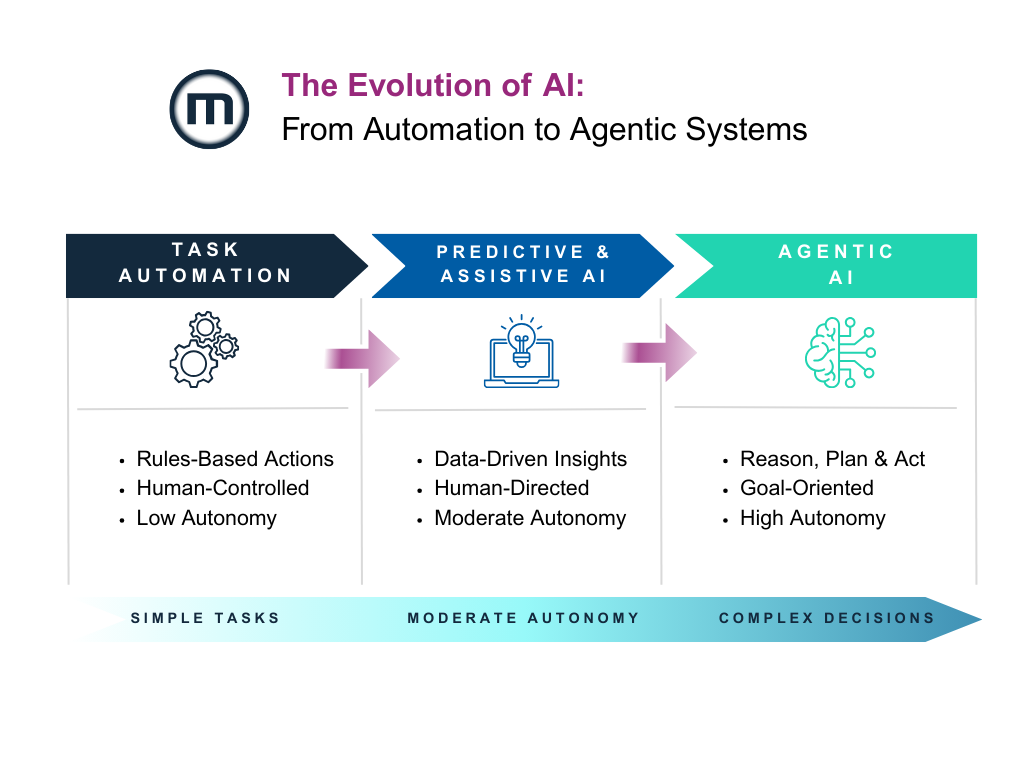
This shift isn’t theoretical. Most leaders can feel it.
Agentic AI is accelerating the change. Unlike earlier forms of AI that respond to prompts or support specific tasks, Agentic AI introduces systems that can reason, plan, and take action toward defined outcomes.
That sounds exciting. It’s also where things get complicated.
Once systems start influencing how work is coordinated and how decisions are made, the questions stop being technical and start being organizational. Who is accountable. Where judgment sits. How much autonomy is too much.
This is where many AI efforts slow down or stall.
When AI is introduced without trusted data, clear governance, or teams that understand how to work alongside it, things break down quickly. Efforts fragment. Trust erodes. Instead of creating clarity, AI adds noise.
Autonomy without alignment creates more problems than it solves.
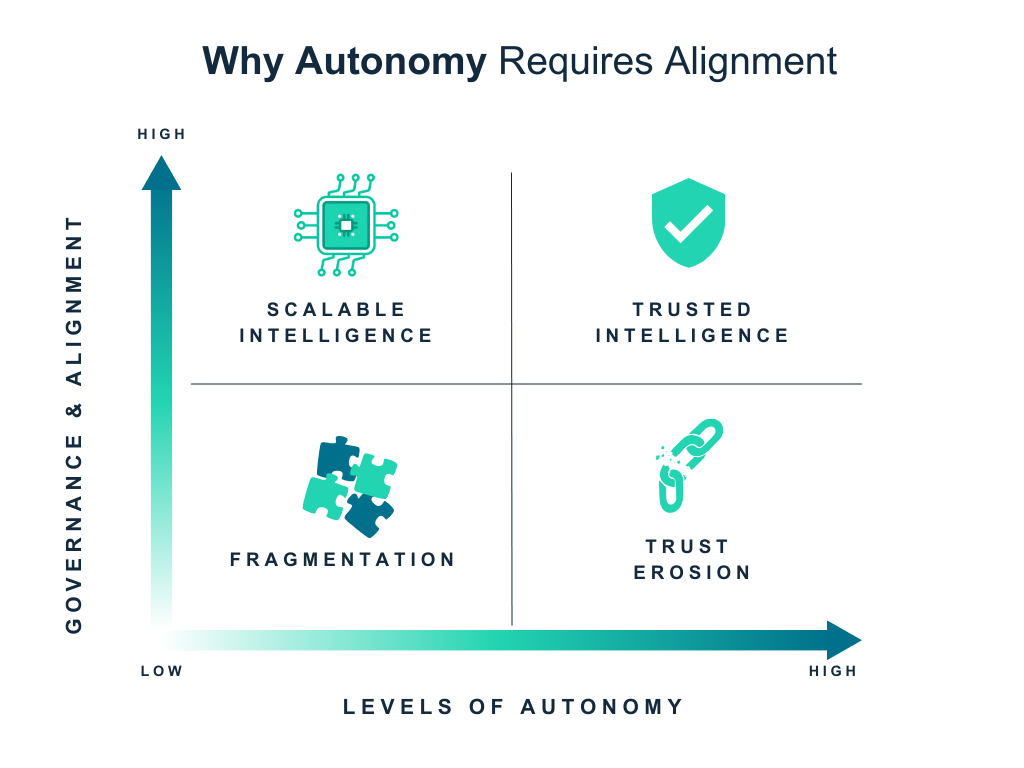
The organizations that succeed will be the ones that learn how to use the intelligence already embedded in their own data, systems, and operations. In many cases, that intelligence has been there for years. What’s changed is the ability and the willingness to act on it.
This is where Mariner comes in.
Mariner helps organizations build the foundations that make AI work in the real world.
Our experience across data, cybersecurity, and change management is directly applicable here. These capabilities are not adjacent to AI adoption. They are what enable it. Trusted data provides the raw material. Governance sets boundaries and expectations. Change management helps people understand what is changing and how their roles evolve as intelligence becomes part of daily work.
Without these pieces in place, even the best AI tools struggle to deliver value.
These foundations are also what make Agentic AI possible. Autonomous systems only work when the data behind them is reliable, the rules are clear, and people remain accountable as machines take on more responsibility.
This matters most in environments where reliability, security, and public trust are non-negotiable. Healthcare. Telecom. Education. Utilities.
In these contexts, getting AI wrong has consequences.
Our Point of View
We don’t see AI as a side initiative or a technology trend to chase. AI is reshaping how organizations operate at a fundamental level.
Agentic AI takes this further. Instead of people manually coordinating every step, intelligent systems can begin to manage complexity across workflows. That changes where effort is spent. Less time managing handoffs and chasing information. More time focused on judgment, direction, and outcomes.
This is harder than it sounds.
The value of AI doesn’t come from the model alone. It shows up when intelligence is woven into how people work, how processes flow, and how decisions are made. It depends on governance, risk, and compliance being part of the design from the start, not layered on later.
As AI systems become more autonomous, human oversight becomes more important, not less.
At Mariner, we believe strongly in a human-in-the-loop approach. People remain accountable for outcomes, even as intelligent systems manage complexity and scale. We’ve seen what happens when this balance is ignored, especially in regulated and high-trust environments.
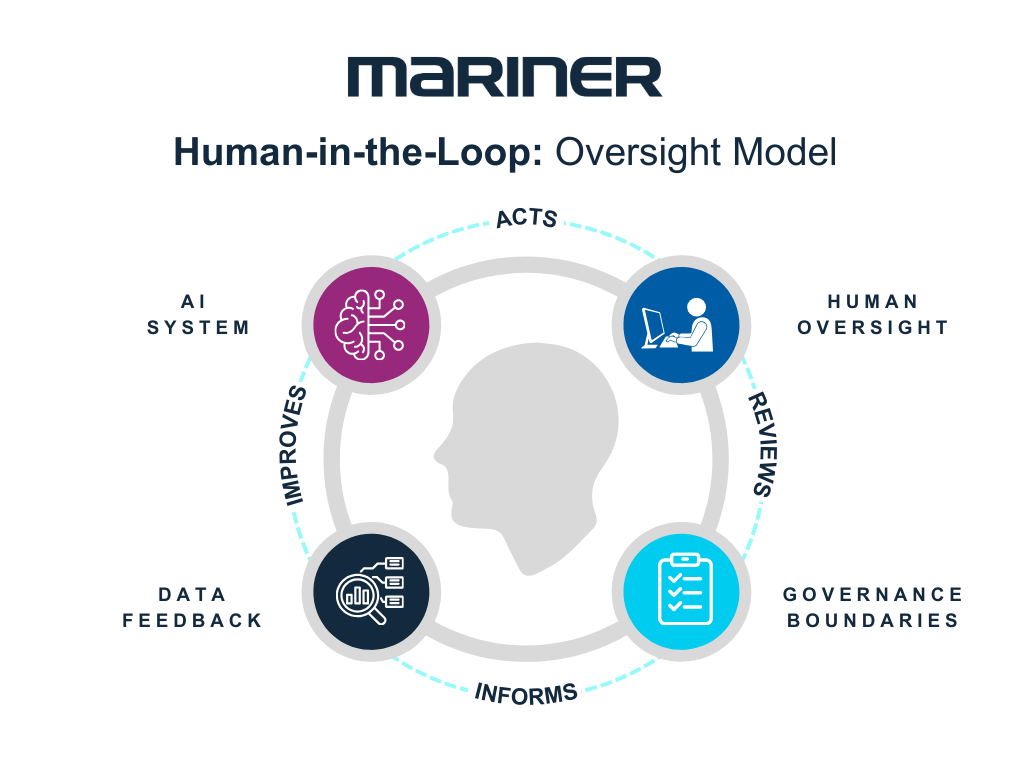 AI should strengthen human judgment, not replace it.
That belief shapes how we approach every AI initiative.
How We’re Different
What sets Mariner apart is not that we work with AI. Many organizations do. The difference is that we understand what needs to be in place before AI can succeed.
We approach AI through a transformation lens. That means helping leaders think through how work changes, how roles evolve, and how decisions are made as intelligence becomes part of the operating model. We support organizations from early strategy through implementation and scale, so adoption is intentional rather than experimental.
AI and Agentic AI are not isolated capabilities at Mariner. They show up across our work in data, cybersecurity, delivery, and change management. This allows us to support clients holistically as they navigate complex change.
Human-centered design remains central to our approach.
We design AI systems with people in the loop, ensuring oversight, accountability, and confidence as autonomy increases. This allows organizations to scale intelligent systems without losing control or clarity.
Proof Through Our Practice
This isn’t theoretical for us. We’re working through the same shift ourselves.
At Mariner, we’re building an intelligence core grounded in our own organizational data. We’re developing agents and agentic workflows that support how our teams work and deliver value every day. The goal isn’t experimentation for its own sake. It’s practical application that improves decision-making, efficiency, and outcomes.
Early on, we thought better tools might be enough.
They weren’t.
Progress required structure. Shared understanding. Clear guardrails. It required people to stay involved, even as systems became more capable.
That’s why our internal work is supported by deliberate enablement. We run AI lunch and learns. We support a network of AI champions aligned to a shared strategy. We provide implementation blueprints and hold regular office hours with our AI and automation teams.
This work keeps adoption practical and grounded.
What we learn internally directly informs how we design and evolve our services. It allows us to help clients build the same foundations for intelligent, agent-enabled operations.
AI is becoming a core part of how organizations compete and grow. Agentic AI will accelerate that change, bringing both opportunity and responsibility with it.
Mariner helps organizations navigate this shift with confidence. By grounding AI in trusted data, clear governance, and human accountability, we help intelligence scale in a way that delivers real value and holds up over time. Connect with our team today to see how you can make this a reality in your organization.
Prepared By:
Adriana Rivas, Manager, Sales Enablement
Chris Frame, Director, Business Information Systems
Further Reading
To see how AI adoption fits into a wider transformation context, read The Pace of Change Accelerated in 2025: What’s Driving Canada’s Healthcare Transformation.